
About co-ops and mutuals
Globally, cooperatives comprise over 3 million enterprises, serve more than 1 billion members, and operate in every country and major sector of the economy.
They are the largest democratic business network in the world.
A cooperative is a member-owned and controlled business from which benefits are derived and distributed equitably on the basis of use.
Cooperatives operate similarly to other businesses but they do have a number of unique characteristics.
They are owned and democratically controlled by their members – the people who use the cooperative’s services or buy its goods, not by outside investors.
They return surplus revenues to their members in proportion to their use of the co-op, not in proportion to their investment or share ownership.
They meet their members’ needs rather than maximising the cooperative’s profit.
Co-ops, mutuals and the wider economy
Cooperatives and mutuals operate across the full economy, from small community organisations to large national enterprises.
International evidence shows that member-owned businesses contribute to:
Employment stability and decent work
Regional and rural development
Fair access to essential services
Economic resilience during downturns
“A cooperative is an autonomous association of persons united voluntarily to meet their common economic, social and cultural needs and aspirations through a jointly-owned and democratically-controlled enterprise.”
International Cooperative AllianceWhy cooperatives exist
Cooperatives exist to meet members’ needs, not to maximise profit for outsiders.
They focus on long-term value, fairness, and resilience.
How cooperatives make decisions
Members have an equal say.
Most cooperatives operate on a one-member, one-vote basis, regardless of how much capital a member has invested.
What happens to profits?
Surpluses are reinvested or returned to members.
Returns are usually based on use of the cooperative, not on share ownership.
Where cooperatives operate
Cooperatives operate across the whole economy.
In New Zealand this includes food and fibre, retail, housing, finance, energy, services, and community organisations.
What is a mutual?
A mutual is a member-owned organisation that provides services to its members.
Mutuals are common in banking, insurance, health, and professional services.
Co-ops and mutuals
Cooperatives and mutuals are both member-owned businesses.
They share similar values and governance but may be recognised differently in law or statistics. All mutuals are co-ops but not all co-ops re mutuals.
A history of the cooperative movement
How did the first successful co-op start?
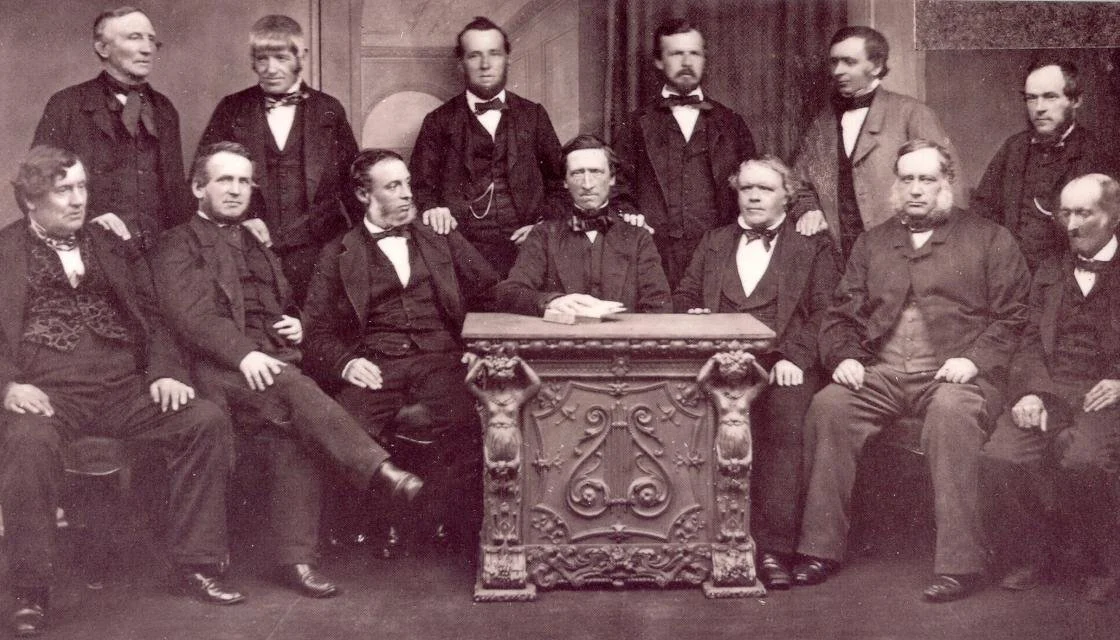
The first successful co-op was formed in 1844 in Rochdale, Lancashire. At that time, living conditions in northern industrial towns were tough. Flour, sugar, butter and oats were expensive. Often, milk was watered down and mill owners mixed their flour with sawdust to increase their profits.
A group of 28 working-class men decided to change this. They raised the funds to set up a cooperative shop that provided good quality products to the community, at a fair price.
The Rochdale Pioneers as they are now commonly known, spurred on a movement that has spread throughout the world and continues to thrive today.
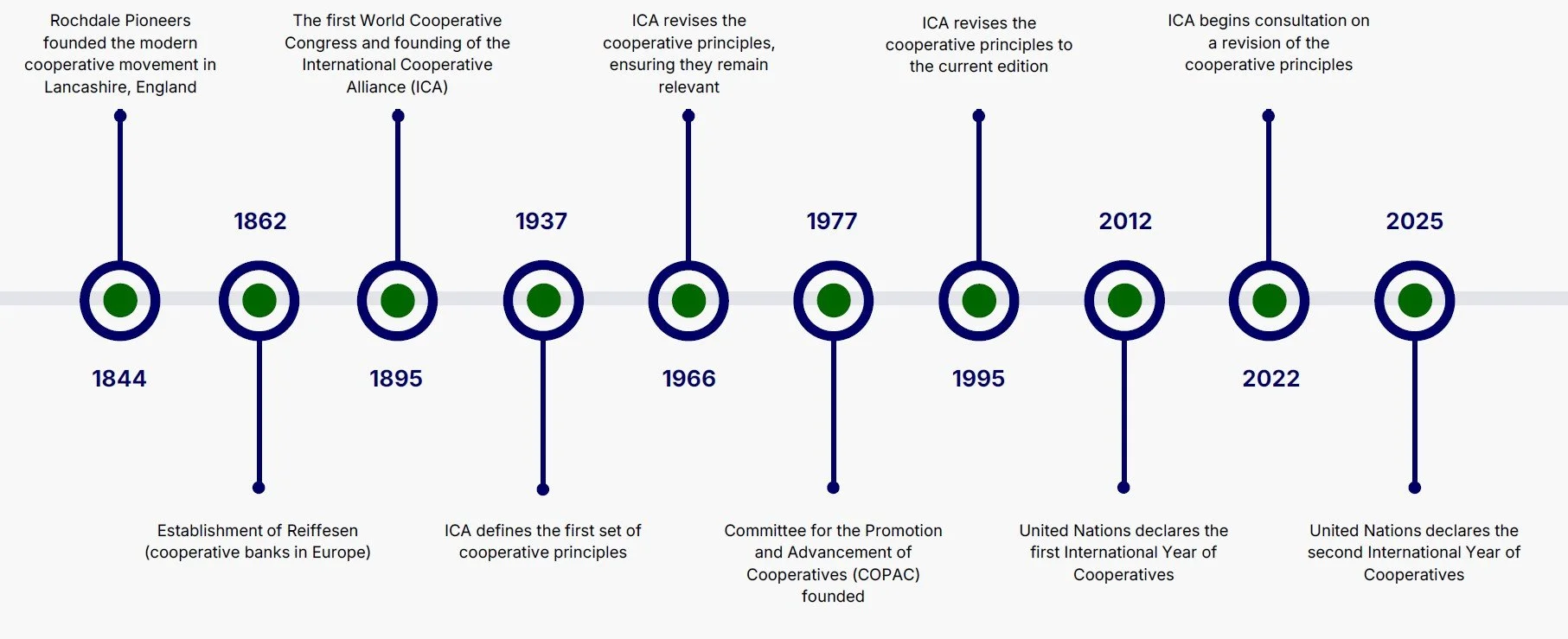

Today more than 12% of humanity are members of at least one of the world’s 3 million co-ops
Core co-op values and principles
Co-ops welcome everyone and are open to all persons able to use their services and willing to accept the responsibilities of membership without gender, social, racial, political or religious discrimination. offering benefits to those who join and fulfill their duties. Co-ops and mutuals are connecting and welcoming, collecting diverse perspectives and skills.
01. Inclusivity
Equal say and accountability. Co-ops are democratic organisations controlled by their members, who actively participate in setting policies and making decisions. Co-ops and mutuals are equitable and empowering.
02. Democracy
Shared ownership and benefits. Members contribute equitably to and democratically control, the capital of their cooperative. The co-op structure supports and enables family owned businesses to scale and thrive.
03. Economic participation
Co-ops are autonomous, self-help organisations controlled by their members. Co-op members chart their own course, building towards shared goals. If they enter into agreements with other organisations or raise capital from external sources, they do so on terms to retain democratic control by their members and maintain their cooperative autonomy.
04. Autonomy
Co-ops invest in informed decision making and accountability by educating members and the public. Shared knowledge means everyone benefits from collective wisdom.
05. Education and information
The cooperative movement is stronger by working together nationally, locally, regionally or internationally. Cooperation amongst cooperatives means co-ops become a system, working together.
06. Collaboration
Co-ops and mutuals work for the sustainable development of their communities through policies approved by their members. This cycle of community value-creation works to strengthen communities. Why? Because every member of a co-op is also a member of their community. Far less value drifts offshore in a co-op model.
07. Community focus
Types of cooperatives
In New Zealand, cooperatives are commonly described by the relationship between members and the enterprise. While internationally, the International Labour Organization groups cooperatives into four broad categories for statistical consistency, New Zealand cooperatives often span more than one ILO category. International guidelines recognise this and allow national classifications to reflect local practice. The definitions below are New Zealand definitions.
-
A cooperative where members produce similar types of products such as crops, livestock, milk, or crafts. By banding together, combining supply volumes and resources to process and market their products, greater economies of scale are achieved. These cooperatives are common in New Zealand and include Fonterra, Silver Fern Farms Co-operative, MG Group, Walnuts NZ and NZ Hops.
-
Owned by the people who work in the business. Members’ jobs are provided through the cooperative itself, with workers collectively responsible for governance and performance. Less common in New Zealand than Europe, in this type of cooperative ownership model supports staff retention by involving them in business decisions and sharing in the profits. Examples are Ion Technologies and Loomio. Many taxi companies are also registered Industrial and Provident Societies, and are therefore cooperatives.
-
Owned by customers or users of goods and services. These cooperatives exist to provide fair access, quality, and affordability rather than to maximise profit. These include co-ops that deliver utilities to their members. Examples include MHV Water, LIC, Farmlands, and RuralCo.
Housing co-ops are also a type of consumer cooperative and a large part of Europe’s housing stock, they fill the gap between social housing and private ownership. While rare in New Zealand, they are also common in the US and are growing in popularity in Australia. The properties are usually owned by the cooperative but controlled by the members (tenants) and are effective financial managers of housing as tenants have a sense of ownership and control in their management.
-
Known by any of these terms, purchasing/shared services or buying group cooperatives are owned and governed by independent business owners that come together to enhance their purchasing power, lower their costs and improve their competitiveness and ability to provide quality services and products. Examples are Mitre 10, NZPM Co-operative, Foodstuffs, Paper Plus, ITM and Buildlink.
-
Insurance mutuals are owned entirely by those who take out policies. Surpluses are most often used to reduce future premiums and reinvest in the community or are distributed as dividends. Examples include FMG (Farmers Mutual Group), PPS Mutual and Southern Cross Medical Care Society.
-
Financial services cooperatives belong to their members, who are at the same time owners and customers. They are set up as a bank, building society or credit union. Examples include SBS Bank, Nelson Building Society and First Credit Union.
-
Platform cooperatives are evolving models based on a centralised technology platform that members sign up to that enables them to access or share various services. They are starting to become more prevalent globally, but are rare in New Zealand. A notable example of a platform cooperative in the US is The Drivers Cooperative, a ride-hailing service in New York City and Denver where drivers own and operate the platform. It's a worker-owned cooperative designed to compete with companies like Uber and Lyft. In New Zealand, stock photography co-op Truestock is an example of a platform co-op.