Manchester's worker-owned cooperative Unicorn Grocery has spent 30 years showing that grocery retail can operate differently. Its experience raises some interesting questions about competition, local food systems and the opportunities for new forms of business ownership in New Zealand.
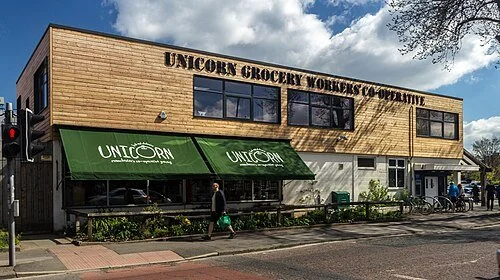
On a busy shopping street in Manchester, England, there is a supermarket that has been doing things differently for 30 years. It sells fresh organic produce, grains, pulses, nuts, seeds and everyday grocery staples. It has a substantial warehouse, a car park, established supplier relationships and thousands of customers coming through its doors each week. It also has no conventional shareholders, no chief executive and no traditional management hierarchy.
Unicorn Grocery is owned and run by the people who work there.
And that makes it especially interesting in the context of New Zealand’s continuing debate about grocery competition. Not because Unicorn Grocery provides a model New Zealand could simply copy. It doesn’t. Rather, it challenges an assumption that can sit beneath discussions about grocery competition: that more competition necessarily means more businesses that look and operate like the supermarkets already in the market.
In our recent article, Cooperative Business New Zealand explored how cooperative structures have helped independent New Zealand grocery businesses achieve scale and compete, and why we believe greater attention should be given to encouraging new forms of competition rather than structurally separating existing, lawfully formed cooperatives.
Unicorn Grocery shows us what just one of those alternatives can look like.
Competing differently, rather than replicating what's already there
Founded in 1996, Unicorn has developed into a substantial independent grocery business, with approximately 6,500 customer visits each week. Its original ambition was to create a wholefood supermarket where people could complete much of their regular grocery shopping, rather than a small specialist store catering to a narrow market.
Its proposition is captured in a simple sign outside the shop: "Good food for all."
Speaking recently with Cooperative Business New Zealand, Unicorn worker-member Leah de Quattro explained that affordability has always been central to the business, particularly when it comes to making organic food accessible to ordinary households.
"Unicorn focuses on competing where its sourcing model and core product range provide an advantage." Leah explained. All its fresh fruit and vegetables are organic, and it offers an extensive range of wholefoods, including grains, pulses, nuts and seeds. These basic grocery lines are priced very competitively, with organic goods often beating non-organic prices from the 'big four' mainstream supermarket chains in the UK (Tesco, Asda, Sainsburys and Morrisons).
While Unicorn is not the lowest price retailer for every product, its pricing strategy ensures a fair price for growers as well as customers.
Unicorn has deliberately chosen to focus on the products it believes should be more widely available and affordable, rather than attempting to reproduce the entire range offered by a conventional supermarket. It does not sell meat, dairy or eggs, leaving other retailers to meet those needs.
There is also considerable commercial discipline behind the proposition. Unicorn's co-located warehouse is approximately the same size as its retail floor, allowing the business to buy in bulk, source directly from suppliers, and minimise unnecessary handling. As Leah explained, one of the practical principles behind the operation is simply to "touch stuff less."
The result is a retailer that competes on price where it can, while giving customers other reasons to shop there as well.
So, what could this mean for New Zealand? When we talk about encouraging more grocery competition, do we assume that every entrant needs to look like the supermarkets already here? Much of the discussion here has been about separating or replicating existing models, including through inviting large international retailers to set up in New Zealand. Yet grocery retailing requires significant investment in distribution, technology, warehousing, purchasing capability and physical stores.
Replicating all that comes at considerable cost, particularly in a relatively small and geographically dispersed country like New Zealand.
Perhaps the more interesting policy question, then, is not how every new grocery business can be encouraged to build its own supply chain, warehouse and technology platform. It is whether some of those capabilities could be shared, purchased or accessed in ways that lower barriers to entry while preserving vigorous competition between retailers.
New entrants would not necessarily need to reproduce every element of an established supermarket business to provide customers with meaningful additional choice.
A different kind of supermarket
The ownership of Unicorn Grocery is perhaps its most distinctive feature. There is no chief executive sitting above the cooperative. The people buying produce, managing finances, stocking shelves and running the operation collectively own the business.
New Zealand is very familiar with producer cooperatives such as Fonterra, where producers (farmer-shareholders in Fonterra’s case) collectively own a business that processes or markets their products, and retailer cooperatives such as Foodstuffs and Mitre 10, where independent business owners share purchasing power, infrastructure and other capabilities.
A worker cooperative is different again. Its members are the people employed within the business, who collectively own and govern it.
Today Unicorn has 53 worker-members, with a smaller proportion of its work undertaken by casual employees. All worker-members receive the same hourly pay, regardless of their role or length of service.
Its governance structure has evolved considerably over three decades. In the early years, a relatively small group could make decisions collectively. As the business grew, that approach became increasingly difficult. Today, Unicorn uses a system of smaller groups, known as circles, which are responsible for different areas of the operation, including purchasing, finance, personnel and marketing.
These groups have defined responsibilities and decision-making authority, while major strategic decisions remain with the wider membership. The business also invests significantly in training, allowing employees to develop expertise and move between different functions.
Leah was open about the challenges of maintaining effective collective decision-making as Unicorn grew. At one point, the cooperative had around 70 worker-members, and its governance arrangements needed to adapt to the increasing complexity of the business.
Worker ownership does not remove the challenges of running a successful enterprise and alternative ownership is not a substitute for commercial viability. A worker cooperative still has to earn customers, control costs, manage its supply chain, invest, develop commercial expertise and make difficult decisions.
Unicorn Grocery’s experience instead demonstrates that it is possible to combine a different form of ownership with the commercial discipline required to survive in a fiercely competitive industry.
It can also create a different relationship between employees and the business they are building. Unicorn's members describe themselves as stewards, responsible for looking after the enterprise and passing it on to future generations.
For a business now celebrating its 30th anniversary, that perspective on ownership and longevity is one very familiar to New Zealand's rural sector with its deep cooperative roots.
If the model works, why aren't there more?
One of the most revealing parts of our conversation with Leah concerned Unicorn's early ambitions.
When the cooperative was established, its founders drew inspiration from another worker-owned wholefood business and a concept known as Blueprint for 50 Co-ops. The idea was that there could be room for around 50 similar grocery businesses across the UK, particularly in cities with sufficient population and customer demand.
Thirty years later, Unicorn remains one of relatively few businesses operating at this scale under a comparable model.
As Leah put it, "Why aren't there 50?"
The answer is partly that establishing a grocery business is difficult, regardless of ownership. It requires capital, suitable premises, supplier relationships, stock management, logistics, retail expertise and sufficient customers to sustain the operation.
Worker cooperatives face additional considerations, particularly around collective governance, access to capital and building a group of people with the skills and commitment to establish and operate the enterprise.
Unicorn itself has raised finance from its community through loan stock, including to help purchase its premises. This enabled supporters to provide capital without taking ownership or control away from the workers.
The cooperative has also chosen not to expand into a conventional chain. Instead, it has made its commercial experience available to others through its Grow a Grocery guide, sharing practical information about establishing and running a wholefood cooperative. The guide covers business planning, premises, pricing, staffing and governance, alongside the realities of working collectively.
This is a different approach to growth, and a wonderfully cooperative one. Rather than expanding one enterprise into more locations, Unicorn is helping others explore whether similar businesses could be established in their own communities, adapted to local circumstances.
We feel there is something particularly appealing about that approach in the context of New Zealand, with our smaller population centres and regional differences.
More than a shop: supporting a wider food ecosystem
Unicorn's relationships with growers are central to how the business operates and illustrate how different grocery models can contribute to the wider food system.
The cooperative works directly with many UK growers, including producers in northwest England. Its buying teams engage in crop planning, helping growers anticipate demand and plan production with greater confidence. It also pays suppliers promptly, generally within a couple of weeks, recognising the importance of cash flow for smaller businesses.
Perhaps most interesting is Unicorn's growers' fund, financed through a proportion of its fruit and vegetable sales. The fund supports investments in infrastructure such as protected growing facilities and storage, helping producers manage changing weather conditions, extend growing seasons and maintain supply. Over the years, Unicorn has also experimented with more direct involvement in food production, learning where its own commercial strengths lie and how best to support others.
There are parallels for New Zealand, where growers face challenges ranging from weather volatility and rising input costs to access to markets and the economics of supplying large retail networks. A more diverse grocery sector could create additional routes to market, particularly for smaller growers whose products, volumes or particular propositions may not fit conventional supermarket supply arrangements.
That doesn't necessarily translate into lower prices in every case. As Leah pointed out during our conversation, diversity also contributes to resilience. Different sourcing relationships and distribution channels can help a food system respond to disruption, support producers and maintain access to food across different communities.
This is particularly relevant in regional New Zealand, where smaller populations and long distances can make grocery retailing challenging. Our established retailer cooperatives demonstrate the value of shared scale, enabling independent businesses to compete for customers while benefiting from collective purchasing, distribution networks and other infrastructure that would be difficult or costly to develop individually.
Could similar principles help other forms of grocery enterprise emerge?
What could this mean for New Zealand?
Unicorn is not a ready-made blueprint for New Zealand. Our population is smaller and more geographically dispersed, our distribution economics are different, and we have different food production systems, consumer preferences and regulatory settings.
Nor should we assume that every new grocery competitor needs to be a worker cooperative. Consumer-owned stores, community grocery enterprises, producer-to-consumer models, regional buying groups and independent retailers could all contribute to a more diverse grocery market.
The important point is that these enterprises do not necessarily need to become national supermarket chains to contribute to competition.
A worker-owned grocery might succeed in one of our larger urban centres by focusing on particular food categories or sourcing relationships. Community-owned businesses could play a role in smaller centres. Independent retailers could collaborate on purchasing or logistics.
There is an important distinction here between competition at the retail level and cooperation behind the scenes.
New Zealand's retailer cooperatives already demonstrate how independently owned businesses can compete vigorously for customers while sharing purchasing, distribution, technology and other capabilities that would be difficult or costly to develop individually.
Could new worker-owned, consumer-owned or community grocery businesses access infrastructure or collaborate in similar ways?
Rather than expecting every entrant to replicate an entire grocery system, there may be opportunities to make it easier for different businesses to build on infrastructure and capabilities that already exist.
An opportunity hiding in plain sight: succession
There is another pathway to more diverse ownership that deserves greater attention: business succession.
Starting a grocery business from nothing is extremely difficult. Transferring the ownership of an existing successful business is different.
An established independent grocer, specialist food retailer or other local enterprise already has customers, premises, employees, operating systems, suppliers and trading history.
When its owner wants to retire or sell, the future of that business can be uncertain.
Employee ownership, potentially through a worker cooperative or another ownership structure, could provide an alternative pathway. Rather than creating competition from scratch, succession through employee ownership could help preserve existing competition while diversifying ownership.
A transition could keep an established business operating, preserve jobs and supplier relationships, maintain local ownership and allow the people already working within the enterprise to participate in its future.
For New Zealand, that may ultimately prove a more practical route to employee ownership than expecting groups of workers to establish supermarkets from the ground up.
Could we create better conditions for different businesses to emerge?
Scotland provides an interesting example of how alternative ownership can become part of wider economic development policy.
The Community Wealth Building (Scotland) Act 2026 requires the Scottish Government to consider measures promoting or supporting employee-owned businesses, cooperatives and social enterprises. It also requires ministers to set out steps to encourage specified Scottish economic development institutions to increase the number and development of employee-owned businesses.
Through this principle could aspiring cooperative founders in New Zealand access specialist feasibility work, business planning, governance advice and appropriate financing?
Could employee ownership become a more readily understood succession option for otherwise viable New Zealand businesses?
Could smaller retailers collaborate more easily around purchasing, technology and logistics?
And are there regulatory, financial or institutional barriers that make establishing cooperative businesses unnecessarily difficult?
A national cooperative development programme, supported by specialist expertise and appropriate financing, is one option worth exploring, and an ambition Cooperative Business New Zealand is keen to support. The objective should be to give commercially promising enterprises a reasonable opportunity to test their viability, obtain the expertise and capital they need and compete for customers.
More competition, more diversity and more resilience
New Zealand has a long history of using cooperation to overcome the challenges of distance, limited scale and access to markets. Our well-established, successful producer and retailer cooperatives demonstrate how businesses can share resources and build collective capability while retaining independent ownership.
Unicorn Grocery offers another perspective. For 30 years, its worker-members have built a business that competes with established supermarkets, provides an alternative route-to-market for growers and offers customers a different grocery proposition.
Its success has required much more than an alternative ownership structure. It has depended on a clear commercial strategy, disciplined operations, committed employees and long-term relationships across its food supply chain.
But its experience also challenges us to think more broadly about what grocery competition could look like.
A more diverse grocery market might include retailer-owned cooperatives, consumer-owned stores, worker-owned businesses, independent retailers and other community enterprises. Some might compete primarily on price, others through their product range, sourcing relationships, convenience or service to particular communities.
These businesses do not need to become a national supermarket chain to make a worthwhile contribution.
New Zealand's grocery debate understandably focuses on the businesses already operating and how effectively they compete.
But there is another side to the competition equation: how easy is it for somebody new to enter?
Unicorn Grocery doesn't provide a blueprint for New Zealand. It provides something more useful: evidence that grocery businesses do not all need the same ownership structure, product range or operating model to provide genuine competition and customer choice.
As New Zealand considers the future of grocery competition, we should be asking not only how competition can be improved among the businesses already here, but what would make it easier for New Zealanders to establish, own and grow different kinds of grocery businesses in the first place.
Interested in more perspectives from Unicorn? Check out this 2019 interview or 2026 Youtube interview.
Read more articles